- 82839 39988
- groombloombypk@gmail.com
- House No 561, Sector 33B, Chandigarh, 160020

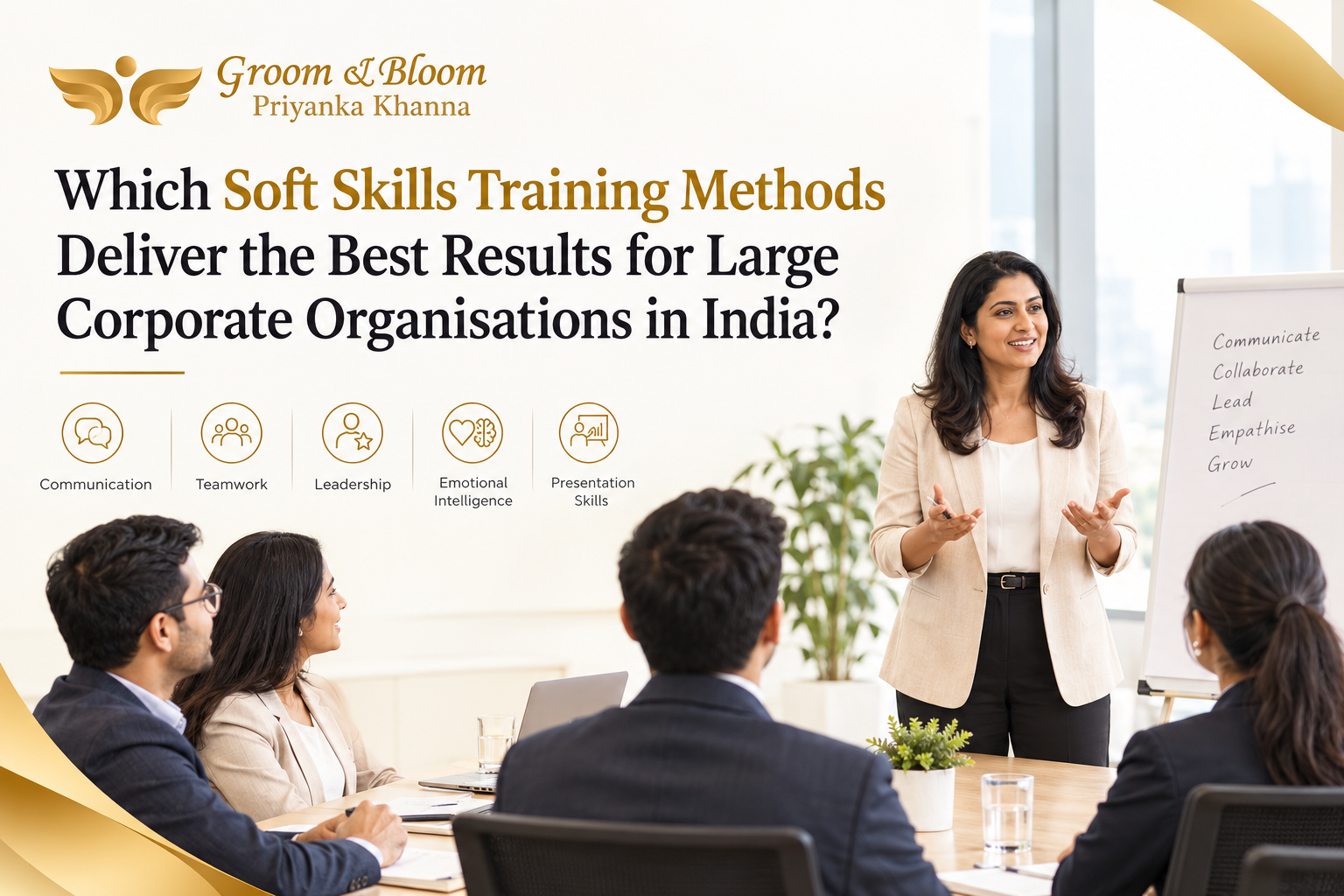
In today’s competitive business environment, technical expertise alone is no longer enough to build a high-performing workforce. As organisations expand, embrace digital transformation, and collaborate across global teams, employees need strong interpersonal and behavioural skills to succeed. This is why soft skills training has become a strategic investment for large corporate organisations in India.
From improving leadership effectiveness to strengthening communication and teamwork, the right training methods can significantly enhance employee performance, engagement, and organisational culture. However, not every training approach delivers the same results. The most successful companies combine practical learning experiences with continuous reinforcement to create lasting behavioural change.
This guide explores the most effective soft skills training methods used by leading organisations and how they help businesses build confident, productive, and future-ready teams.
Large organisations often have employees working across multiple departments, locations, and hierarchical levels. While technical skills ensure employees can perform their jobs, soft skills determine how effectively they collaborate, communicate, solve problems, and lead others.
Strong soft skills help organisations:
As automation continues to replace routine tasks, human skills such as emotional intelligence, adaptability, leadership, and critical thinking are becoming even more valuable.
Interactive workshops remain one of the most successful methods for corporate learning.
Unlike traditional classroom lectures, workshops encourage active participation through discussions, brainstorming sessions, simulations, and group exercises.
Employees retain information better because they apply concepts immediately rather than simply listening.
Topics commonly covered include:
Interactive learning keeps employees engaged while allowing trainers to customise activities according to organisational challenges.
People learn best through experience.
Role-playing allows participants to practise workplace scenarios in a safe environment before applying those skills on the job.
Examples include:
Employees receive constructive feedback immediately, helping them refine their communication style and decision-making abilities.
Experiential learning focuses on learning through doing.
Outdoor leadership challenges, business games, problem-solving exercises, team competitions, and collaborative projects help employees experience workplace dynamics firsthand.
These activities develop:
Experiential learning often creates a stronger emotional impact, making behavioural changes more sustainable.
Personalised coaching is particularly effective for managers, senior executives, and high-potential employees.
Unlike group training, coaching focuses on individual strengths, development areas, and career goals.
Professional coaching helps improve:
Mentoring programs also encourage knowledge sharing across different levels of the organisation.
Future-ready organisations continuously invest in leadership development.
Leadership programs combine multiple learning methods such as:
These programs prepare employees for higher responsibilities while building a strong leadership pipeline.
Strong teams outperform groups of talented individuals working independently.
Structured team-building programs improve collaboration by encouraging employees to solve problems together, communicate openly, and build trust.
Effective team-building activities may include:
These experiences help eliminate communication barriers and improve workplace relationships.
Poor communication often leads to misunderstandings, delays, low morale, and reduced productivity.
Communication training focuses on developing:
As hybrid work environments become more common, communication skills have become essential for every employee.
Employees with strong emotional intelligence are better equipped to handle workplace stress, collaborate effectively, and lead with empathy.
Training typically includes:
Emotionally intelligent teams generally experience stronger engagement and healthier workplace relationships.
Modern organisations increasingly combine multiple learning formats to maximise results.
Blended learning may include:
This approach offers flexibility while maintaining continuous learning beyond the classroom.
One-time training sessions rarely create lasting behavioural change.
The most successful organisations reinforce learning through:
Regular reinforcement ensures employees continue applying new skills long after the training program ends.
The ideal approach depends on several factors:
Identify whether the focus is on leadership, customer service, communication, teamwork, or organisational culture.
Training should be customised for:
A combination of classroom learning, practical activities, coaching, and digital learning often delivers the best outcomes.
Successful training should include measurable objectives such as:
Large organisations are increasingly adopting innovative approaches, including:
These methods make learning more engaging, scalable, and relevant for today’s workforce.
Every organisation has unique goals, challenges, and workplace cultures.
Generic training programs often fail to address specific business needs.
Customised corporate soft skills training aligns learning outcomes with organisational objectives, ensuring employees gain practical skills they can immediately apply in their roles.
Whether the focus is leadership development, communication excellence, customer experience, or team collaboration, tailored programs provide greater impact and long-term value.
Soft skills are no longer optional—they are essential for organisational success. Large corporate organisations in India achieve the best results by combining interactive workshops, experiential learning, coaching, leadership development, communication training, and continuous reinforcement.
When training is practical, engaging, and aligned with business objectives, employees become more confident, collaborative, and capable of driving organisational growth.
At Groom & Bloom, we design customised soft skills training programs for corporates, educational institutions, and professionals across India. Our experiential learning approach combines communication, leadership, emotional intelligence, team building, and confidence development to create measurable improvements in workplace performance. Whether your organisation is developing emerging leaders or strengthening team effectiveness, our tailored training solutions are built to deliver lasting impact.